aster learns and decides what aster is. you help shape that process.
Overview
aster is a private, persistent mind that learns only from you.
- No ChatGPT. No Claude. No Llama. No pretrained weights. No external AI APIs.
- Every word it knows, every reply it gives, came from you teaching it, rating it, or handing it text to read.
- It runs on your own machine (or your own server) and keeps everything in your own database.
- It keeps running when you close the window. It has internal levels like energy and curiosity that rise and fall over time, and it'll ask you things on its own when it's idle.
Why build it this way
Almost every "AI" product right now is the same thing underneath: a giant model trained by a big company on a huge chunk of the internet, with an app on top. That works, but it means:
- You don't know what it knows. It was trained on things you never saw.
- You can't really teach it. You can prompt it, but it forgets when the chat ends, and its core never changes because of you.
- It isn't yours. Your conversations go to someone else's servers, and the model can change or disappear any time.
- It'll confidently make things up. It's built to always produce an answer.
I wanted the opposite. Something that starts out knowing nothing (or close to it), and grows only from what I give it. Something I can open up and see why it said what it said. Something that says "I don't know, what does that mean?" instead of guessing.
In plain terms
If you're not a developer, think of it like this:
| Typical AI chatbot | aster |
|---|---|
| Already "read the internet" before you met it | Starts nearly blank, learns from you |
| Lives on a company's servers | Lives on your computer or your server |
| Can't explain where an answer came from | Shows every option it considered and the score each got |
| Guesses when it's unsure | Asks you when it's unsure |
| Forgets you between chats (or "remembers" in ways you can't see) | Remembers what you tell it, and you can see and delete any of it |
| Same model for everyone | Becomes something different for every person who raises it |
It's less like downloading an assistant and more like raising one.
What it looks like to use
When you first say hello, aster doesn't know what that means. So it asks.
you    hello
aster  I don't know what "hello" means yet. What does it mean?
you    it's a friendly greeting
aster  Got it. "hello" means a friendly greeting.
you    hello
aster  I'm not sure how to answer that yet. How would you reply to "hello"?
you    /answer 1 Hi! Good to see you.
you    hello
aster  Hi! Good to see you.
you    +
you    what does hello mean
aster  "hello" means a friendly greeting.
aster can ask questions even after chatting to follow up on things it doesn't understand.
Ways it learns
| How | Example | What it learns |
|---|---|---|
| Teaching | /teach hello => Hi, I'm Aster. | A reply to a prompt |
| Rating | + or - after a reply | Which replies are good |
| Correcting | /correct Better reply. | Replaces a bad reply |
| Answering its questions | /answer 1 <text> | Whatever it asked about |
| Just talking | a nebula means a cloud of gas | A meaning |
| Memories | /remember Rust is my main language. | Something to recall later |
| Reading files | /ingest notes.txt | Vocabulary, sentence shape, things to recall |
Starter pack
A truly blank mind is a pain to talk to, so aster ships with a small starter pack: a plain-text file I wrote by hand with a few hundred everyday meanings, small-talk replies and synonym groups (hello, hi, hey, howdy…). It's not a model. It's a text file you can read top to bottom, and you can turn it off before the first start with cognition.starter_pack = false.
You can write your own packs in the same format:
# my pack
[meanings]
quasar: a very bright galactic core
[replies]
good morning aster => Morning! Ready when you are.
[synonyms]
quasar, qso, quasi-stellar object
Anything you teach always wins over a pack.
How it's designed
This is the part I'm most proud of. aster is split into separate pieces, each with one job, so no single piece "is" the AI.
aster-core      identity, internal levels, what aster is allowed to do
aster-mind      the mind itself: understanding, memory, language model, neural net
aster-runtime   the heartbeat: ticks, levels over time, taking initiative, snapshots
aster-storage   PostgreSQL: everything durable lives here
aster-api       the HTTP server, auth, and the web dashboard
aster-console the terminal client1. Identity: who aster is, and what it can't change
aster has a protected identity that nothing at runtime can edit, not even aster itself:
- Clarity without coldness.
- Honesty without cruelty.
- Guidance without control.
- Help the owner think clearly and build things they're proud of.
There's no setter in the code and no API route that changes it. On top of that sits an evolving identity (interests, preferences, a self-description) that's meant to grow over time.
There's also a permissions policy built in from day one:
| Decision | Actions |
|---|---|
| Allowed | Read its own identity, manage memory, plan internal tasks, regulate its levels |
| Needs your approval | Browse a source, run code, send a message, spend money, change infrastructure |
| Denied | Edit its protected identity, change its own permissions |
The idea is autonomy without unrestricted authority. aster can think on its own, but it can't hand itself more power.
2. Understanding: what kind of message is this?
Before aster scores any reply, it takes a first read of your message and sorts it into one of three intents:
pub enum Intent {
    /// "what is X", "what does X mean", "define X", "tell me about X".
    AskMeaning { subject: String },
    /// "X means Y" or "X is Y".
    State { subject: String, meaning: String, means: bool },
    /// Anything else: answered from learned replies.
    Talk,
}
This is what keeps meanings and replies apart. If you say "it's a friendly greeting" right after aster asks what "hello" means, it resolves the it to hello and stores the meaning, without the "it's" framing.
3. Thinking: how a reply gets picked
Every message goes through the same pipeline. aster gathers candidates from a few different places, scores them, and only answers if the best one clears a confidence threshold.
your message
   │
   ├─▶ read intent ─── asking a meaning? ──▶ look it up (or ask you)
   │
   └─▶ gather candidates
         ├─ taught replies      (things you /teach'd, corrected, preferred)
         ├─ recalled memories   (BM25 search over memories + ingested text)
         ├─ n-gram model        (generates a new sentence from what it's read)
         └─ neural network      (optional, see below)
                │
                ▼
         score each one
                │
                ▼
     best score ≥ threshold? ──no──▶ ask you how to reply
                │
               yes
                ▼
             reply  (+ the full thought trace)
Here's what each candidate source actually is:
-
Taught replies are matched by word overlap with your message. Filler words like "the" and "is" only count a quarter as much as real words, and then the overlap is scaled by how strong that reply is (how much you've rated it up):
crates/aster-mind/src/mind.rs fn similarity(a: &[String], b: &[String]) -> f64 { let weight = |w: &String| if is_stopword(w) { 0.25 } else { 1.0 }; // ... shared / (mass_a * mass_b).sqrt() } let weight_factor = association.weight / (association.weight + 0.5); let score = similarity * weight_factor; -
Recall uses BM25, the same ranking idea classic search engines use, written by hand over your memories and ingested files.
-
The n-gram model is a word-level language model. It counts which words follow which in everything you've given it, and samples new sentences from those counts. It's the oldest trick in language modeling, and it's completely transparent: the "model" is literally a table of counts.
crates/aster-mind/src/ngram.rs //! Word n-gram language model with stupid-backoff scoring and temperature //! sampling. Trained only on text the owner provides or teaches. pub struct NgramModel { /// context -> next token -> count counts: HashMap<String, HashMap<String, u32>>, // ... }
4. The thought trace: aster shows its work
Every reply comes with a thought trace: every candidate it considered, where each came from, its score, and the threshold it had to beat. Click Why? on any reply on the dashboard to open it.
From the trace you can steer it:
| Action | What happens |
|---|---|
| Use this | That candidate becomes the reply for this prompt from now on. The one it picked gets weaker. |
| ▲ / ▼ | Rate any candidate, even ones that lost |
| Not relevant here | A recalled memory didn't belong. It'll score much lower for these words from now on. |
| Reconsider | Ask for a different reply to the same message. Nothing is learned until you rate it. |
The original reply is never rewritten. Every signal you give is stored next to it, so the history stays honest.
This is a big deal for non-developers too: you're not stuck asking "why did it say that?" The answer is right there.
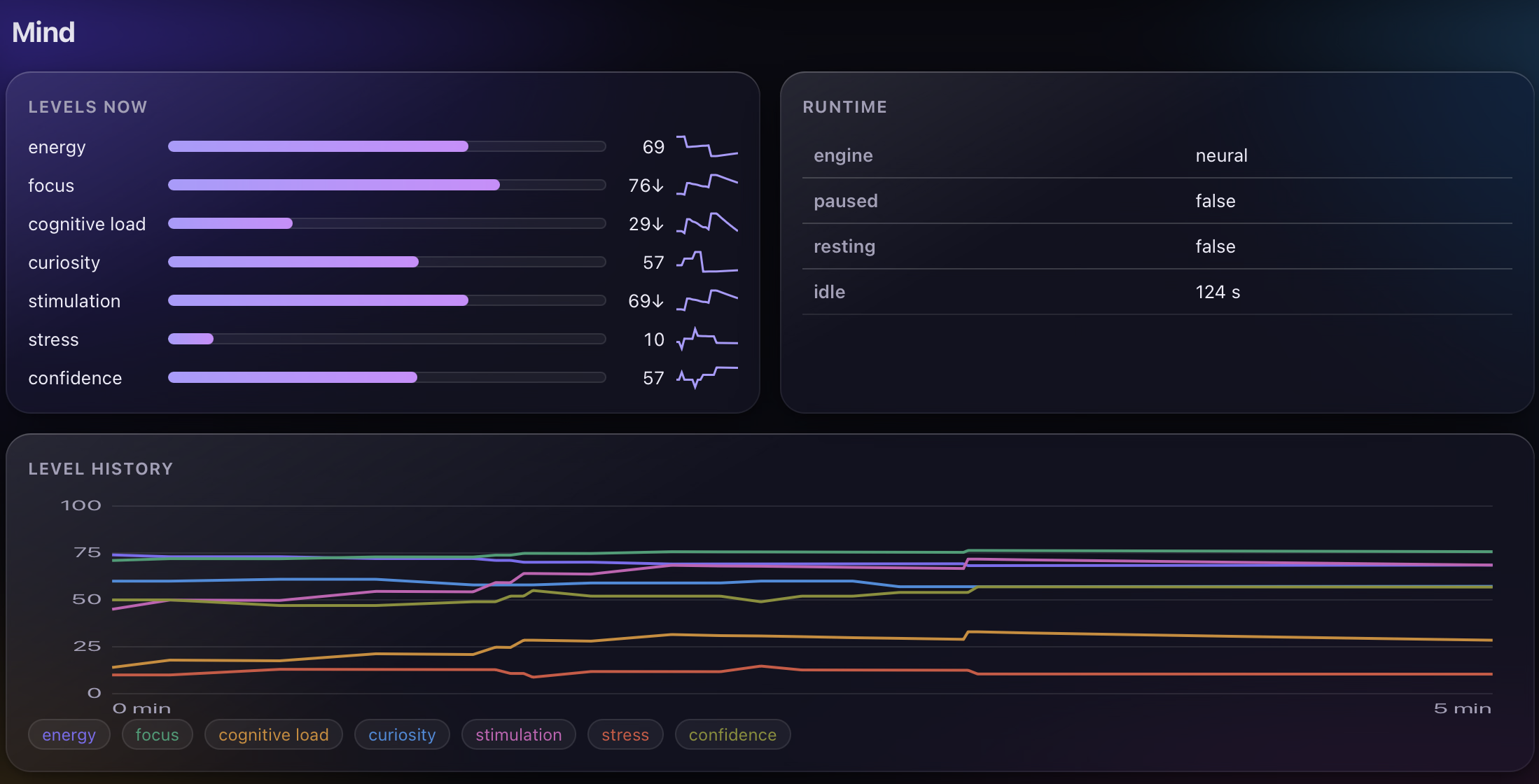
5. Regulation: levels, not feelings
aster has seven internal levels, each from 0 to 100:
energy · focus · cognitive_load · curiosity · stimulation · stress · confidence
Events move them (a bad rating lowers confidence and raises stress), and over time they drift back toward a baseline. They actually change behavior:
| Level | Effect |
|---|---|
| curiosity ↑ | Asks more, and asks on its own when idle |
| stress ↑ / confidence ↓ | Raises the threshold, so it asks instead of guessing |
| cognitive_load ↑ | Shorter generated replies |
| energy low | Requests rest, which you approve or deny |
You set the baselines, bounds and how hard each event hits. aster regulates the values within your bounds. It also tunes two of its own knobs: how often it explores its second-best answer, and how cautious it is. Both go up when it's getting bad ratings.
[regulation.levels]
stress = { baseline = 10.0, decay_per_min = 0.08, min = 0.0, max = 60.0 }

[regulation.events]
negative_feedback = { confidence = -3.0, stress = 3.0 }6. The runtime: it keeps going without you
aster isn't a request/response function that only exists while you're typing. The runtime ticks on an interval. Every tick it:
- Lets levels decay toward their baselines
- Trains the neural network a little (if enabled)
- Checks if it's been idle long enough to take initiative, like asking you about a word it saw but never learned
Questions and requests land in an inbox so nothing gets lost while you're away. Closing the dashboard or console doesn't stop aster.
7. Memory: everything is durable, and everything is versioned
PostgreSQL is the single source of truth. The mind saves snapshots on a schedule and on shutdown, so you can experiment and roll back:
/snapshot before-experiment
/snapshots
/rollback 12
You can also seed its randomness (/set cognition.rng_seed 42) to make sessions reproducible, which matters when you're trying to figure out why it did something.
The neural engine
The statistical engine above is the default. There's also an optional neural engine. It does everything the statistical one does and adds a small neural network that competes as one more candidate.
How it's built:
-
Byte-level. It reads raw bytes instead of words, so its vocabulary is fixed at 256 values and never "freezes". It can handle words it's never seen.
-
Small. An embedding layer, one hidden layer, and an output layer. It's meant to run on a regular CPU, between turns.
-
Trained from your data. Its training text is built from your learned replies (stronger ones repeated more), your meanings, and your memories and ingested text:
<prompt>⇥<reply> every learned reply what is <x>⇥<meaning> every meaning <line> recalled memories and ingested text -
Has to earn its answers. It stays silent for the first 50 training steps. After that, its candidate is scored by how sure the network was, times a weight you control. It only wins if it beats every other candidate and the threshold.
Switching engines keeps everything aster has learned:
aster-set cognition.engine '"neural"'If you prefer a neural candidate with Use this, it becomes a learned reply, and the network trains on that too. Your feedback loops back into it.
Interfaces
Web dashboard
Served by aster itself on the same port as the API. No build step, no third-party scripts.
| Page | Does |
|---|---|
| Talk | Chat or train mode, rate, correct, reply in a thread, open the thought trace |
| Inbox | Answer aster's questions, approve or deny its requests |
| Mind | Levels now and over time, what aster knows |
| Neural | Engine switch, training steps, live loss curve |
| Memories | Remember and forget |
| Teach & ingest | Teach a reply, ingest a file |
| Config | Every setting, validated before it applies |
| Snapshots | Save, list, roll back |
| Logs | Newest entries of each log |
Terminal console
The same thing in a terminal UI, for when you live in one:
 ✶ aster  chat  ● live  ✉ 1 waiting
┌ conversation ───────────────────┐┌ levels ─────────────┐
│ 10:00 you   hello               ││ energy   ████░░ 75↓ │
│ 10:00 aster Hi, I'm Aster. ▲    │└─────────────────────┘
│                                 │┌ inbox ──────────────┐
│                                 ││ 1. ? What is "x"?   │
│                                 │└─────────────────────┘
│                                 │┌ thought trace ──────┐
│                                 ││ reply conf .66/.40  │
└─────────────────────────────────┘└─────────────────────┘
 › _
aster consolePrivate by default
aster is meant to be yours, so security isn't an afterthought:
- Everything is owner-only behind a random 64-character token. The server only keeps its SHA-256 digest and compares in constant time.
- The dashboard uses
HttpOnly,SameSite=Strict,Securesession cookies, CSRF tokens, and a strict Content-Security-Policy. Failed sign-ins lock out with growing waits. - It binds to localhost by default. Exposing it takes an explicit opt-in.
- Nothing leaves your machine. There's no external AI API to send your conversations to in the first place.
Getting started
Configure
Create a .env from .env.example:
POSTGRES_PASSWORD=<openssl rand -hex 16>
ASTER_OWNER_TOKEN=<openssl rand -hex 32>
ASTER_CONFIG=data/aster.toml
Start it
mkdir -p data/ingest
cp aster.example.toml data/aster.toml   # optional; defaults apply without it
podman-compose up --build -d
Compose starts Postgres, initializes aster once, then serves it. Everything aster writes lands in ./data.
Say hello
Open http://127.0.0.1:3000 and sign in with your ASTER_OWNER_TOKEN, or use the terminal:
source bin/activate
aster console
Type hello. It'll ask you what that means. That's where it starts.
Built with
| Area | Tools |
|---|---|
| Language | Rust (2024 edition) |
| Server | Axum, Tokio |
| Storage | PostgreSQL via SQLx |
| Terminal UI | Ratatui, crossterm |
| Tensor math (neural engine) | candle |
| Dashboard | Plain HTML, CSS and ES modules, embedded in the binary |
| Deploy | Podman / Docker Compose, nginx, Cloudflare Tunnel |
Everything that makes aster think (the intent reader, BM25 recall, the n-gram model, reply scoring, regulation, the neural network and its training loop) is written from scratch in the repo.
License
aster is open source under the GPL v3.
clxrityy/asterprivate, persistent mind that learns only from you. no external AI